
Vaporized hydrogen peroxide (VHP) is widely used for bio-decontamination in pharmaceutical isolators. For an installed glove system, suitability involves three questions: can the agent reach the surfaces requiring treatment, does the glove retain the necessary properties after repeated exposure, and are residuals adequately controlled?
Hydrogen peroxide resistance is a starting point for selection. A complete suitability assessment also identifies the glove, the actual VHP process and its condition after repeated use. The same material name, cycle count or apparently similar cumulative exposure can describe substantially different operating histories.
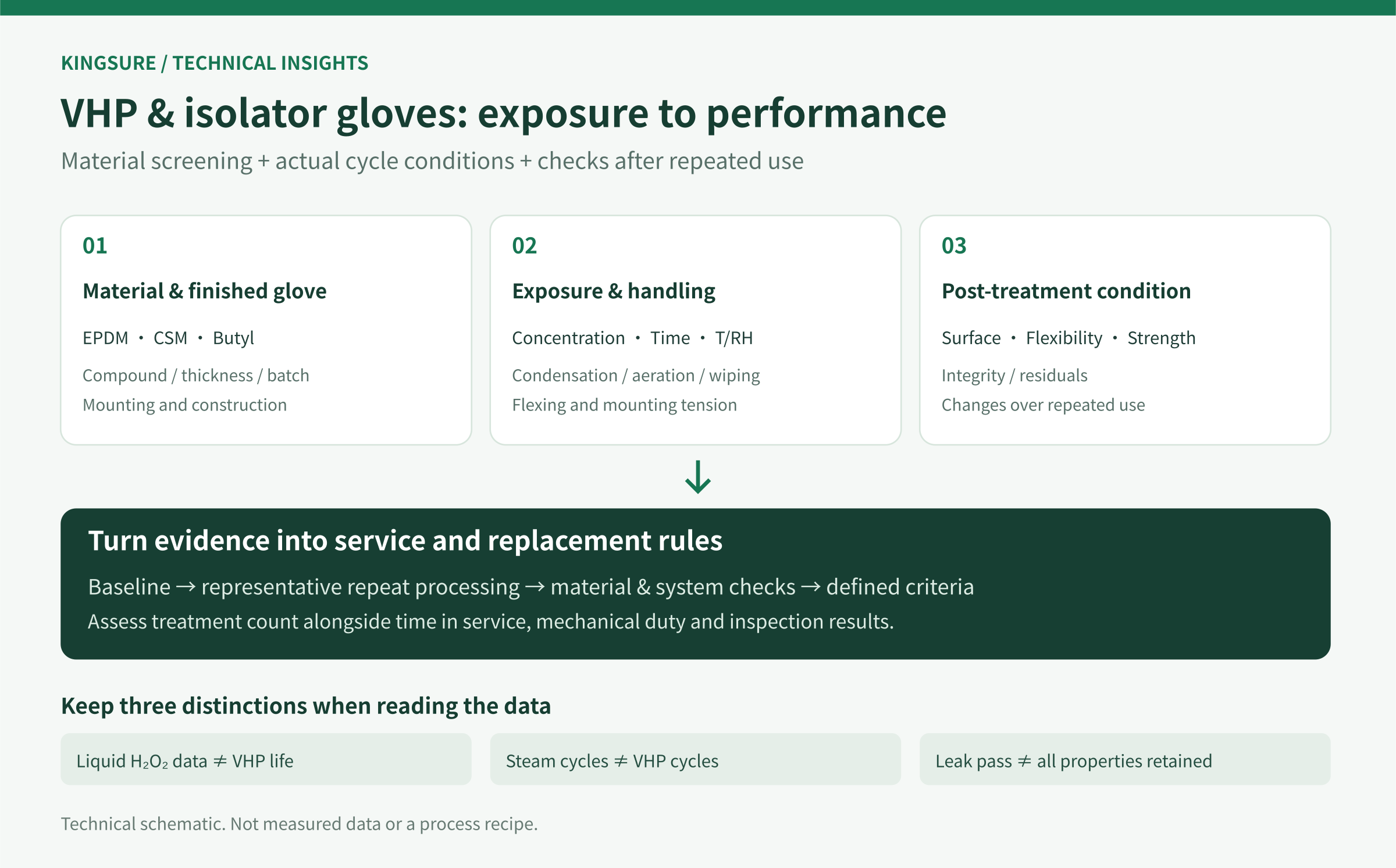
1. VHP and liquid hydrogen peroxide involve different contact conditions
VHP means vaporized hydrogen peroxide; technical literature also uses vH₂O₂. This article addresses bio-decontamination of gloves installed in isolators. Its process objectives, equipment conditions and validation should be distinguished from VHP terminal sterilization of medical devices.[1][2]
Liquid immersion tests typically describe solution concentration as a mass fraction, such as 30% hydrogen peroxide. A VHP process normally records vapor concentration, exposure time, temperature and the humidity conditions created by water and hydrogen peroxide together. Gas-phase ppm is commonly reported on a volume basis; confirm the instrument and report definitions.[7]
The following information cannot simply be converted into equivalent claims:
| Available information | What it supports | What still needs confirmation |
|---|---|---|
| Permeation or degradation results for 30% liquid hydrogen peroxide | Chemical performance of the specified glove under the stated liquid-contact conditions | Repeated exposure and ageing in the actual VHP process |
| Normal appearance after one VHP cycle | No obvious abnormality was observed during that inspection | Mechanical properties, integrity and cumulative-use performance |
| A specified number of steam sterilization cycles | Resistance under the stated steam process | Suitability and repeat-use limits for VHP |
| Chemical protection ratings for a new glove | Performance in the relevant standard tests | Property retention after repeated decontamination and use |
For example, PIERCAN instructions for a 0.6 mm CSM glove report permeation classification and degradation results for 30% hydrogen peroxide. These concern the specified product and liquid test conditions; they do not establish its VHP cycle life.[3]
2. How can VHP exposure affect a glove?
2.1 Material properties: appearance is only an initial observation
Hydrogen peroxide is an oxidizing agent. Repeated-exposure assessment should consider surface condition, flexibility, tensile strength, elongation at break and other mechanical properties relevant to the application.
In general elastomer ageing, chain scission and changes in cross-linking can alter the polymer network. Chain scission can cause softening and loss of elasticity, while additional cross-linking can increase stiffness and reduce extensibility. These mechanisms help explain ageing; they do not demonstrate that every glove undergoes the same changes after VHP treatment. Results from elevated-temperature ageing research cannot be transferred directly into isolator-glove VHP service-life claims.[4]
Tackiness, hardening, cracks or discoloration observed in use require investigation alongside the compound, exposure history and other chemicals present. One symptom alone rarely establishes that VHP caused the damage.
2.2 Sorption and desorption: materials can also affect the cycle
The interaction is bidirectional. Exposure may affect a material, while that material may adsorb, absorb or promote decomposition of hydrogen peroxide, influencing chamber concentration and aeration. Vaisala notes that material-specific absorption and release require case-by-case assessment.[5][6]
Assess the glove system in its installed state and representative load configuration. Increasing glove numbers, changing sleeve construction or replacing a material can justify change assessment to determine whether the existing concentration and aeration profiles remain representative.
Hydrogen peroxide can decompose into water and oxygen. That does not establish the absence of residual peroxide within all materials at the end of a cycle. Residual assessment should reflect product sensitivity and process requirements; occupational exposure and product-quality requirements address different concerns.[6]
2.3 Material changes can combine with mechanical fatigue
Installed gloves also experience stretching, flexing, gripping, tool contact and mounting tension. If their properties change in service, damage may become more apparent at finger roots, the thumb web, palm folds and loaded cuff areas.
Repeated exposure of an uninstalled test specimen can support material screening. Confirmation with an installed glove and representative manipulations is closer to actual service. This is an engineering recommendation for isolator applications, rather than a fixed failure pattern for a particular polymer.
3. Why is a VHP cycle count insufficient on its own?
A cycle is not a universal exposure unit. Conditions during preparation, injection, dwell and aeration can all affect the exposure experienced by the material. A useful record includes:
| Variable | What to record | Relevance to glove assessment |
|---|---|---|
| Vapor concentration | Setpoint, measured profile, peak, sensor location and units | Distinguishes the programmed process from actual exposure |
| Exposure duration | Stage durations and complete cycle time | Avoids comparing only the dwell phase |
| Temperature | Chamber conditions and relevant cold/warm locations | Affects condensation conditions and material response |
| Humidity state | Initial humidity, RH and relative saturation where applicable | Water and H₂O₂ jointly determine proximity to condensation |
| Condensation | Intended process state and unexpected local wetting | Liquid-film contact differs from vapor-only exposure |
| Installation and load | Port, mounting tension, glove position and shielding/contact | Affects exposure distribution and local mechanical loading |
| Treatment history | Cycle ID, count, intervals and other cleaning/sterilization steps | Captures cumulative and combined processing conditions |
Relative humidity (RH) and relative saturation (RS) are different measurements. In a peroxide-containing vapor mixture, RS accounts for the contribution of both water and hydrogen peroxide to saturation. A colder surface can reach condensation conditions before the monitoring location, so one chamber RH reading does not fully characterize exposure at the glove surface.[5][7]
Technologies differ in how they use and control microcondensation. Interpret condensation against the validated process: it is inappropriate either to classify every instance as a fault or to disregard unexpected local wetting.
Concentration and time records can help compare exposure histories. Equal concentration–time products do not demonstrate equivalent material damage or predict remaining service life. Humidity, temperature, condensation, aeration and intervals between cycles still require assessment.
4. Comparing EPDM, CSM and butyl for VHP applications
Material names support initial screening. Final comparisons should address the compound, finished-glove specification and corresponding evidence.
| Material | Useful selection considerations | Confirmation priorities for VHP applications |
|---|---|---|
| EPDM | Hydrogen-peroxide-related duties and processes also involving repeated steam treatment | Assess steam and VHP separately; confirm flexibility, mechanical properties and integrity after repeated treatment |
| CSM | Oxidizing decontamination agents, ozone and ageing-related requirements | Review finished-product data for the relevant thickness and locations; assess changes alongside VHP and wiping history |
| Butyl rubber, IIR | Gas and water-vapor barrier requirements and protection against specified chemicals | Confirm gas-barrier performance and repeated-VHP compatibility separately; check all process chemicals |
PIERCAN identifies hydrogen peroxide resistance as a feature of its EPDM material. Ansell EPDM product information also describes peroxide chemical resistance and autoclave performance separately. Honeywell emphasizes the gas and vapor barrier properties of its butyl glovebox gloves, a separate selection consideration.[8][9][10]
These sources support application-based screening. They do not establish a universal VHP service-life ranking across brands, compounds and thicknesses. A thicker glove does not automatically provide a proportionally longer life under repeated VHP exposure.
Other materials may also suit a confirmed process. Ansell's technical article on BioClean nitrile isolator gloves discusses VHP and IPA sanitization and lists steam-cycle information separately. Keep the evidence for each processing method distinct when reading such literature.[1]
5. Assessing a glove after repeated VHP exposure
The following framework supports discussions between QA, engineering and suppliers. Define the tests and acceptance criteria before testing, according to the application, supplier information and site risk assessment.
Establish a baseline and consistent retest conditions
Record the model, compound or material identification, batch, thickness, dimensions and port construction. Establish a baseline using comparable unexposed specimens, then assess at planned repeat-treatment milestones.
Measurements immediately after exposure and those made after adequate aeration and conditioning may represent different material states. Standardize aeration, storage and test conditions; assess temporary and persistent changes separately where necessary.
Examine both the material and the installed system
| Assessment area | Possible measurements | Interpretation |
|---|---|---|
| Surface and dimensions | Cracks, tackiness, color, thickness, dimensions and mass change | Identify trends without diagnosing the cause from appearance alone |
| Mechanical properties | Tensile strength, elongation at break and relevant tear/puncture performance | Compare with the baseline and predefined criteria |
| Hardness | Appropriate method, specimen geometry and test conditions | Thin glove walls cannot be assessed using geometry that does not meet the method requirements |
| System integrity | Suitable glove leak testing, port and seal checks | Distinguish material defects, connection issues and test settings |
| Process-related properties | Where relevant, aged chemical barrier performance, residuals, aeration or cleanliness | Determine the scope from product and personnel-protection needs |
Stable hardness, normal appearance and a passed leak test answer different questions. Leak testing identifies detectable leakage paths; it does not also demonstrate unchanged molecular permeation resistance to a particular chemical.
A report may express retention of a mechanical property as the post-exposure value divided by the initial value, multiplied by 100%. Report each property separately. Retention is not a percentage of remaining service life, and there is no single acceptance percentage suitable for every isolator glove.
Read microbiological validation and material-compatibility evidence separately. Biological indicators assess decontamination efficacy; they do not replace confirmation of glove mechanical properties, integrity or service life. Likewise, absence of visible material damage does not demonstrate adequate decontamination of every relevant surface.
6. Managing VHP alongside wiping and steam treatment
The same glove may undergo VHP, IPA or ethanol wiping, contact with other disinfectants, off-line steam sterilization and repeated manipulation. Assessment should represent the approved sequence and frequency of actual treatments.
A VHP-only report supports the exposure conditions it covers. If the site also uses frequent wiping and steam processing, determine whether that combined service history is represented.
Link a unique glove identifier to its model, batch, port position, installation date, treatment records, integrity results and deviations. This helps distinguish time in service, treatment count and concentrated mechanical damage at a particular workstation.
7. What does EU GMP Annex 1 require?
Section 4.21 of EU GMP Annex 1 addresses mechanical and chemical resistance of isolator and RABS glove systems and replacement frequency within the contamination control strategy (CCS). Isolator integrity testing is generally expected at the beginning and end of each batch or campaign, with visual inspection associated with each use and manipulations that could affect integrity.[11]
Section 4.22 addresses controlled cleaning and bio-decontamination; gloves should be extended and fingers separated so the agent reaches the relevant surfaces.[11]
Link material evidence, treatment history, integrity results and replacement rules in the site's glove-management approach. Annex 1 provides neither a universal VHP cycle count for all materials nor a directly applicable number of days between glove replacements.
8. Changes that warrant investigation or replacement
The following table supports site observation and response planning. Approved SOPs and risk assessment determine the specific actions.
| Observation | Factors to investigate | Response direction |
|---|---|---|
| Tackiness, surface transfer or unusual odor | Cleaning/decontamination residues, other chemicals and material changes | Suspend the affected use and assess; avoid masking the symptom with additional solvent wiping |
| Hardening, reduced recovery or increased manipulation resistance | Treatment history, property changes and mounting tension | Compare with the baseline and criteria; apply replacement rules |
| Cracks at finger roots, thumb web or cuff | Flex fatigue, abrasion, mounting stress and chemical exposure | Replace and investigate links to location, tasks and exposure |
| Failed integrity test | Glove defects, port seals, equipment and test settings | Follow deviation procedures and assess affected production activities |
| Unusual aeration time or residual trend | Load, materials, cleaning residues and cycle changes | Investigate the process instead of treating a persistent trend only by extending time |
Discoloration can trigger investigation, but does not alone establish permeation. Absence of discoloration does not demonstrate that every property is unchanged.
9. Kingsure isolator-glove selection support
Kingsure supplies KS5000 EPDM, KS2000 CSM and KS1000 butyl isolator gloves. Selection for a VHP-related application should address process chemicals, decontamination conditions, port size, thickness, installation and operating tasks.
For a process involving steam sterilization, chemical wiping and VHP, record each treatment's conditions and history separately, then review the evidence and confirmation scope for the relevant glove. Kingsure can help match materials and specifications and provide corresponding product information.[12]
For an existing application or a new project, share the VHP process overview, other chemicals, glove specifications and intended service pattern through our contact page.
10. Frequently asked questions
Can both EPDM and CSM be used with VHP?
Both material families have hydrogen-peroxide-related applications and published product information. Suitability and repeat-use limits depend on the model, compound, thickness, actual VHP process and retained performance after repeated treatment.
Does chemical code P under EN ISO 374 mean VHP testing?
P identifies the reference chemical, 30% hydrogen peroxide. It belongs to the chemical protection marking system and does not establish a VHP cycle count or repeated-decontamination service life. Read the specific glove information alongside the EN 374 marking guide.[3]
Can autoclave-cycle data be converted into VHP cycles?
No. The agent, temperature, contact conditions and material effects differ. Use evidence for the corresponding process.[1][9]
Does a passed leak test permit unlimited further VHP treatment?
No. Use the result alongside approved service limits, treatment counts, material condition and deviation history when deciding on continued use or replacement.
How should replacement frequency be established?
Combine product information and process-specific confirmation with treatment history, time in service, mechanical duty and inspection trends. Apply the approved procedure when any replacement condition is reached.
Further reading
- EPDM glove applications and chemical compatibility
- CSM glove applications and chemical resistance
- Reading isolator glove permeation reports
References
Sources checked on 10 November 2026. Brand literature is cited to explain material properties and interpretation of technical evidence. Model-specific results apply to the identified product. The assessment recommendations in this article are not measured results for a particular glove.
- Ansell: RABS & Isolator Gloves for Aseptic Processing | BioClean Nitrile
- STERIS AST: Vaporized Hydrogen Peroxide Processing
- PIERCAN: Instructions—CSM (Y) 0.6 mm Glovebox Gloves, June 2025
- Zaghdoudi et al.: Scission, Cross-Linking, and Physical Relaxation during Thermal Degradation of Elastomers, Polymers, 2019 (general elastomer-ageing mechanisms, not a VHP glove study)
- Vaisala: Questions & Answers on vH₂O₂ Bio-Decontamination in Aseptic Isolators, Part 1
- Vaporized Hydrogen Peroxide Sterilization in the Production of Protein Therapeutics: Uptake and Effects on Product Quality, Journal of Pharmaceutical Sciences
- Vaisala HPP272 User Guide: Measured Parameters and RH/RS Definitions
- PIERCAN: EPDM Black & White
- Ansell: AlphaTec EPDM Plus Isolator Gloves 85-601
- Honeywell: Butyl Glovebox Gloves 10B1532A
- European Commission: EU GMP Annex 1, Manufacture of Sterile Medicinal Products, 2022, Sections 4.21–4.22
- Kingsure: Products and Technical Resources