
A chemical permeation report tells you more about a glove’s compatibility with a particular substance than its material name alone. Results such as “>480 min”, breakthrough time and permeation rate answer different questions.
Breakthrough time is a result obtained under specified test conditions. It supports material comparison and selection, but it cannot be converted directly into a safe working time. Read the sample identity, chemical, test conditions and result definition together.[1][5]
1. Distinguish permeation, penetration and degradation
| Assessment | What happens | Relevant information |
|---|---|---|
| Permeation | A chemical passes through material at the molecular level, potentially without a visible hole | Permeation report, breakthrough time and permeation rate |
| Penetration | A substance passes through holes, seams or other barrier defects | Air-leak, water-leak or other penetration tests |
| Degradation | Chemical contact changes material properties, for example softening, hardening or swelling | Appearance and performance before and after chemical exposure |
These assessments do not replace one another.[4][7][8] EN ISO 374-4 evaluates changes in puncture force after chemical contact; EN ISO 374-2 includes air- and water-leak checks. Passing a leak test does not establish that a chemical cannot move through the material at the molecular level.[7][8]
2. Check these eight report fields first
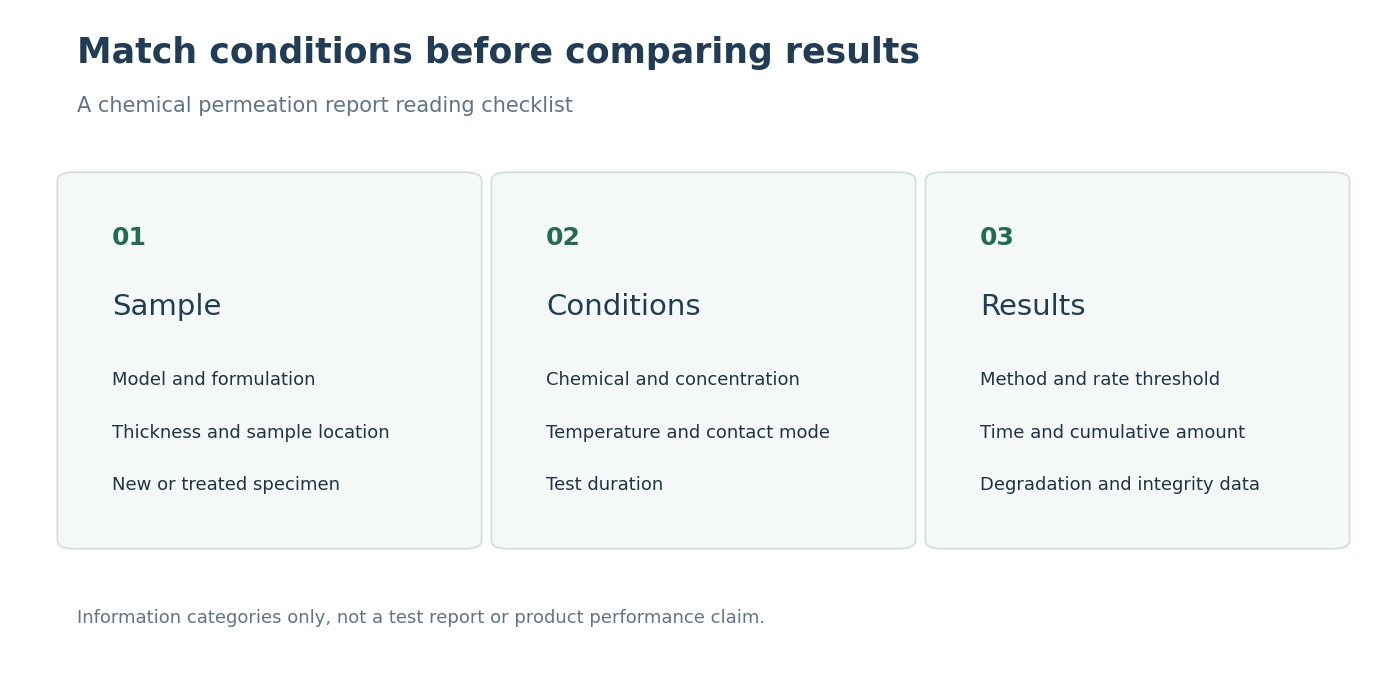
The following sequence helps purchasing, engineering and QA teams read a report and compare models:
| Report field | What to check |
|---|---|
| 1. Sample identity | Model, material formulation, colour and batch correspond to the selected product |
| 2. Thickness and sampled location | Measured thickness and whether the sample came from the palm, finger or sleeve |
| 3. Sample condition | New material or material after sterilisation, cleaning or another treatment |
| 4. Chemical | Name, CAS number, concentration, and whether it is a pure substance or mixture |
| 5. Test method | Standard, edition, and continuous- or intermittent-contact conditions |
| 6. Test conditions | Temperature, duration, collection system and analytical technique |
| 7. Result definition | Detection breakthrough time or normalized/standardized breakthrough time, and the threshold used |
| 8. Result coverage | Individual and summary results, records where the threshold was not reached, and related degradation data |
For example, two EPDM gloves do not automatically share one result when their formulations, thicknesses or treatment histories differ. Align sample and test conditions before comparing their breakthrough times.[4][6]
3. Why can “breakthrough time” have different values?
Detection breakthrough time concerns when the analytical system detects the chemical on the collection side and depends on its detection capability. Normalized or standardized breakthrough time is read at a specified permeation-rate threshold. Always read the value and its definition together.[4]
| Common method or metric | Reporting threshold |
|---|---|
| EN 16523-1 liquid chemical permeation testing | Common normalized threshold: 1.0 μg/cm²/min |
| ASTM F739 standardized breakthrough time | 0.1 μg/cm²/min; a normalized time at 1.0 μg/cm²/min may also be reported |
These thresholds define test metrics; they are not safe human exposure limits.[2][3] A tenfold difference in thresholds does not imply a tenfold difference in breakthrough time or service life. Check the actual threshold and conditions before comparing EN and ASTM reports.
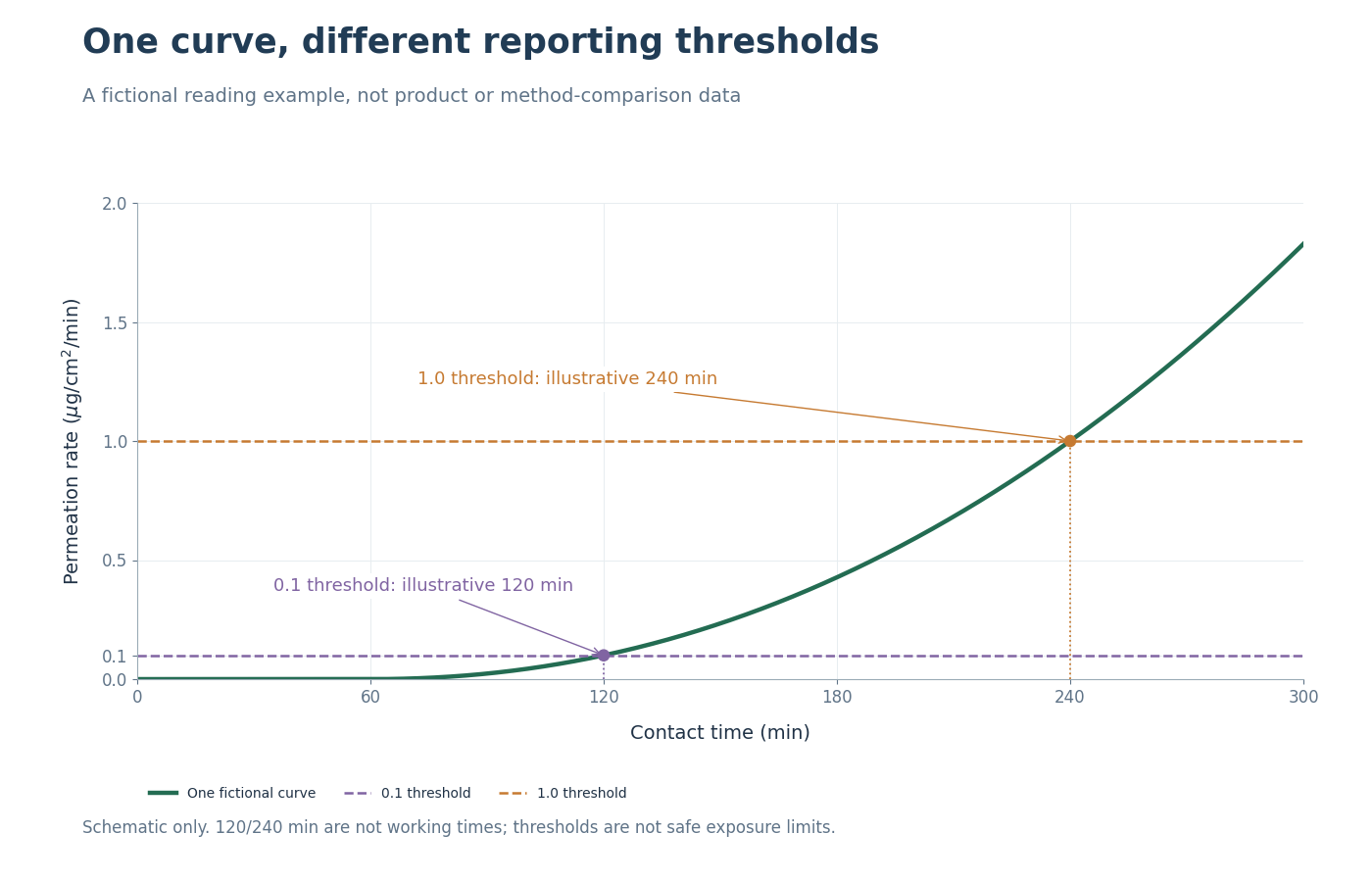
A report may also give permeation rate, the chemical mass passing through a unit area per unit time, and cumulative permeation, the total mass per unit area over a specified period. Typical units are μg/cm²/min and μg/cm² respectively. Materials with similar breakthrough times can have different subsequent rates and cumulative permeation.[3]
4. What does “>480 min” mean?
If a test ends at 480 minutes and the standardized breakthrough result is “>480 min”, it means the specimen did not reach the report’s defined permeation-rate threshold during that test period.[3]
It does not establish that no chemical passed through, or guarantee eight hours of continuous workplace use. Permeation below the threshold may already have occurred, and the result does not describe performance after the test ended.[3][5]
Keep the chemical, concentration, temperature, sample condition, threshold and test end time with the “>480 min” result. Removing those conditions removes essential information about what the number covers.
5. What changes between the laboratory and actual use?
Installed isolator gloves experience flexing, gripping, rubbing and repeated disinfection. Temperature and process formulations may also differ from the test conditions. These factors can affect actual performance.[6][10]
Describe continuous contact and wiping separately. EN 16523-1 and ASTM F739 address continuous contact, while ASTM F1383 addresses intermittent contact. A shorter wiping exposure does not justify simply adding contact minutes or scaling service life from an immersion result.[1][3][9]
Separate pure-chemical results from mixture performance. Data for a pure chemical do not automatically represent every mixed solvent or cleaning formulation containing it.[5][10] Similarly, a new palm specimen does not automatically represent the whole glove, sleeve and attachment after repeated sterilisation.
6. Use the report to support selection and replacement management
Turn the report into practical use information through the following sequence:
- Describe the actual process. Record substances, concentrations, temperatures, contact patterns, task duration and disinfection or sterilisation procedures.
- Match data to the selected model. Compare sample thickness, location and treatment history with the glove specification in use.
- Read protection information together. Consider permeation, degradation, mechanical performance and integrity instead of ranking gloves by a single maximum time.
- Establish inspection and replacement procedures. Include chemical risk, handling demands, treatment cycles and usage records, and update the arrangements when conditions change.
This is a sequence for using the evidence, not a universal time-discount formula. Laboratory breakthrough time supports selection; actual-use procedures also depend on the specific exposure conditions.[5][10]
Frequently asked questions
Does “>480 min” allow eight hours of continuous use?
Not by itself. The result describes a specified test period and threshold. Actual use also depends on the chemical, temperature, mechanical effects and glove condition.
Can reports for different EPDM or CSM brands be compared directly?
First align the model, formulation, measured thickness, specimen condition, chemical and test conditions. A shared material name alone is insufficient for comparison.
Why do EN and ASTM reports show different breakthrough times?
Thresholds, test systems and other conditions may differ. Distinguish detection time from normalized or standardized time, then check the report’s specific definition.
Can a permeation report replace whole-glove or installed-system leak testing?
No. Molecular permeation through material and leaks through holes, attachments or seals are different issues and require the relevant separate test information.
Kingsure offers EPDM, CSM and butyl isolator gloves. For selection support, share the substances, concentrations, temperatures, port dimensions and treatment processes so materials, specifications and technical documentation can be matched to the application.
Related reading: EN 374 glove markings explained. Contact Kingsure.
References
Source and standard information checked on 5 November 2026.
- BSI — EN 16523-1:2015+A1:2018, scope and current status
- SATRA — EN 16523-1, liquid chemical permeation
- ASTM F739-20 — continuous-contact permeation test, public summary
- DuPont SafeSPEC — penetration, permeation and breakthrough terminology
- Ansell — Chemical Glove Selection Process, white paper
- SHIELD Scientific — chemical resistance guide and test conditions
- SATRA — EN ISO 374-4:2019, degradation testing
- SATRA — EN ISO 374-2:2019, penetration testing
- ASTM F1383-20 — intermittent-contact permeation test, public summary
- Ansell — EN 374 change summary, workplace-use limitations