
Isolator gloves often carry EN 374, EN 388 and CE markings, together with shield, flask and biohazard pictograms and a sequence of letters. Each marking refers to a different protective property. Understanding them helps identify which risks have been tested and how the information can support glove selection.
EN 374 principally covers protection against dangerous chemicals and microorganisms. In chemical markings, Type A, B and C identify classifications, while letter codes identify test chemicals. “VIRUS” beneath the microorganism pictogram indicates an additional claim of resistance to virus penetration. These are separate from EN 388 mechanical ratings, glove size and steam sterilisation cycle counts.
This article explains the standards, test principles and marking rules, using a Kingsure isolator glove photograph as a practical example.
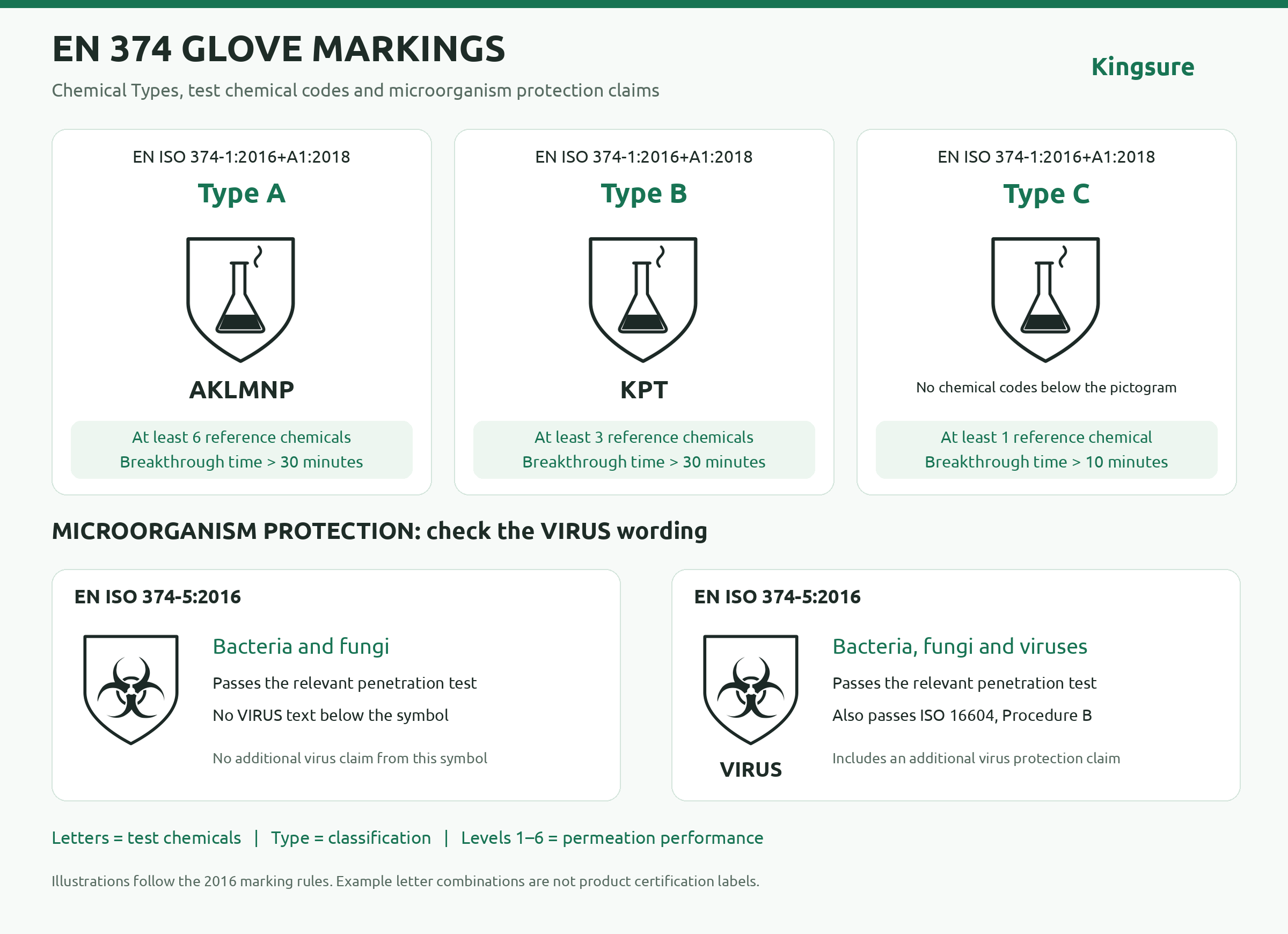
Figure 1. EN 374 marking structure, redrawn to explain the chemical and microorganism marking rules of the 2016 editions. Example letter combinations are not certification labels for a particular product.
1. What is EN 374, and how does it relate to the EU PPE Regulation?
Strictly speaking, EN 374 is a group of protective glove standards, not a separate regulation. EN identifies a European standard; EN ISO identifies the European adoption of the corresponding international standard.
The legal framework for personal protective equipment in the EU is Regulation (EU) 2016/425. It establishes essential health and safety requirements, conformity assessment and CE marking rules. Relevant harmonised standards provide technical assessment methods and support a presumption of conformity within the requirements they cover.[1]
For gloves, the EN 374 series mainly addresses two questions: resistance to dangerous chemicals and the relevant microorganism barrier properties.
| Standard or test method | Main subject | What to look for when reading the marking |
|---|---|---|
| EN ISO 374-1 | Terminology, performance requirements and classification for chemical protection | Type A/B/C and test chemical letter codes |
| EN 374-2 / EN ISO 374-2 | Resistance to penetration, principally air and water leak testing | Leakage through pinholes, seams or other defects |
| EN 16523-1 | Permeation testing under continuous contact with liquid chemicals | Normalised breakthrough time and the corresponding performance level |
| EN ISO 374-4 | Degradation after chemical contact | Changes in puncture force and other relevant test results |
| EN ISO 374-5 | Protection against microorganisms | Bacteria and fungi pictogram, and whether VIRUS is also marked |
The EN 374-3 chemical permeation method found in older documents was replaced by EN 16523-1. Chemical and microorganism protection are addressed separately in Parts 1 and 5.[2]
The Type A/B/C and VIRUS illustrations in this article principally follow the commonly encountered EN ISO 374-1:2016+A1:2018 and EN ISO 374-5:2016 marking rules. ISO has published ISO 374-1:2024 and ISO 374-5:2024. An ISO revision, its European adoption and its citation as an EU harmonised standard are separate matters. Interpret a product according to the edition it declares.[3][4]
2. Three chemical protection assessments: penetration, permeation and degradation
EN 374 chemical protection cannot be assessed solely by checking for leaks. A glove with no visible hole can still allow a chemical to pass through at the molecular level. A glove with a long breakthrough time can also soften or become brittle after contact.
| Concept | How the chemical affects the glove | Main property assessed |
|---|---|---|
| Penetration | Passes through pinholes, seams, pores or other defects | Leakage defects |
| Permeation | Is absorbed by the material, diffuses through it and emerges on the other side | Chemical barrier performance of intact material |
| Degradation | Causes swelling, softening, hardening, cracking or mechanical changes | Changes in material properties after chemical contact |
1. Penetration: checking for leakage paths
Air and water leak tests identify pinholes and other defects. The air test checks for escaping bubbles; the water test checks for water leakage. These assess passage through defects, rather than diffusion of a particular chemical through the rubber itself.[5]
AQL is a sampling acceptance quality criterion used in the relevant batch quality control. It is separate from chemical permeation Levels 1–6 and does not indicate a sterilisation sterility assurance level.
2. Permeation: why can breakthrough occur without visible damage?
Chemical permeation has three stages: the chemical enters the glove’s outer surface, diffuses through the polymer and is released on the inside. This does not require a visible hole.
Routine EN 16523-1 testing uses prescribed temperature conditions of approximately 23°C and 1.0 μg/(cm²·min) as the permeation rate for determining normalised breakthrough. Breakthrough time is the time taken to reach that specified rate; it is not the time at which the first molecule enters the material.[6]
In the marking system discussed here, resistance to permeation is classified using six time thresholds:
| Permeation performance level | Normalised breakthrough time threshold |
|---|---|
| Level 1 | More than 10 minutes |
| Level 2 | More than 30 minutes |
| Level 3 | More than 60 minutes |
| Level 4 | More than 120 minutes |
| Level 5 | More than 240 minutes |
| Level 6 | More than 480 minutes |
These levels are assigned separately to specific test chemicals. The same glove may achieve one level against 40% sodium hydroxide and another against acetone. Technical data should match the chemical name, concentration, breakthrough time and level.[7]
“More than 480 minutes” means breakthrough exceeds 480 minutes under the stated test conditions. It does not mean unlimited resistance or establish an eight-hour continuous-use replacement interval. Temperature, mixtures, contact conditions, rubbing and material condition can affect the barrier in practice.[8]
3. Degradation: assess whether the material weakens, as well as breakthrough time
EN ISO 374-4 quantifies degradation through changes in puncture resistance before and after chemical contact. The relevant method includes exposure under prescribed conditions for approximately 60 minutes, followed by comparison of puncture forces. Degradation results are provided in the instructions for use, rather than as another printed rating sequence beneath the chemical pictogram.[9]
For example, a mean puncture force of 100 N before exposure and 80 N afterwards represents a 20% decrease. It describes a mechanical change; it cannot be converted into remaining minutes of use.
Meeting the permeation requirement for a chemical code does not mean degradation is below a single universal low value. Gloves with the same chemical letters may therefore have different breakthrough times and degradation results. Read both data sets when selecting a glove.
3. How to read the flask pictogram: what do Type A, B and C mean?
Chemical protection commonly uses a flask inside a shield. The full marking includes the standard number, Type classification and, for Type A or B, chemical codes beneath the pictogram.
1. Type classification depends on how many reference chemicals meet the threshold
| Classification | Minimum requirement within the list of 18 reference chemicals | Letters beneath the pictogram |
|---|---|---|
| Type A | At least 6 chemicals achieve permeation Level 2: breakthrough time greater than 30 minutes | Codes for the relevant qualifying chemicals |
| Type B | At least 3 chemicals achieve permeation Level 2: breakthrough time greater than 30 minutes | Codes for the relevant qualifying chemicals |
| Type C | At least 1 chemical achieves permeation Level 1: breakthrough time greater than 10 minutes | No chemical codes beneath the pictogram under this edition’s rules |
These classifications concern permeation performance. Chemical protection claims also involve penetration requirements and the relevant degradation data.[10]
Type A does not mean Level 6 against every chemical, or superior resistance to every individual chemical compared with Type B. It means that more reference chemicals meet the specified threshold. For a particular solvent, read its corresponding data.
2. What do the letters mean? The 18 EN 374 reference chemicals
The letters identify chemicals; they are not general chemical resistance grades. The list uses A–P, plus S and T: Q and R are not included.
| Code | Test chemical | Concentration specified in the reference list | CAS number |
|---|---|---|---|
| A | Methanol | — | 67-56-1 |
| B | Acetone | — | 67-64-1 |
| C | Acetonitrile | — | 75-05-8 |
| D | Dichloromethane | — | 75-09-2 |
| E | Carbon disulfide | — | 75-15-0 |
| F | Toluene | — | 108-88-3 |
| G | Diethylamine | — | 109-89-7 |
| H | Tetrahydrofuran | — | 109-99-9 |
| I | Ethyl acetate | — | 141-78-6 |
| J | n-Heptane | — | 142-82-5 |
| K | Sodium hydroxide | 40% | 1310-73-2 |
| L | Sulfuric acid | 96% | 7664-93-9 |
| M | Nitric acid | 65% | 7697-37-2 |
| N | Acetic acid | 99% | 64-19-7 |
| O | Aqueous ammonia | 25% | 1336-21-6 |
| P | Hydrogen peroxide | 30% | 7722-84-1 |
| S | Hydrofluoric acid | 40% | 7664-39-3 |
| T | Formaldehyde | 37% | 50-00-0 |
“—” means that a separate percentage is not stated in the list entry; it does not mean any concentration may be selected. Reagent specifications follow the applicable standard. See the EN ISO 374 marking guide for codes and chemical names.[11]
An important distinction is the “A” in Type A and chemical code A beneath the flask. The first names the classification; the second identifies methanol.
3. Practical example: Type B + KPT
Suppose a glove is marked “EN ISO 374-1:2016+A1:2018, Type B” with KPT beneath the flask. This indicates:
- K: 40% sodium hydroxide;
- P: 30% hydrogen peroxide;
- T: 37% formaldehyde;
- each of these three listed chemicals achieves at least permeation Level 2, corresponding to a breakthrough time greater than 30 minutes.
KPT does not give the exact breakthrough time for each chemical. K could be Level 6, P Level 3 and T another level. Those details belong in the product’s chemical performance table.[7]
4. The biohazard pictogram and VIRUS: reading microorganism protection
EN ISO 374-5 uses a biohazard symbol inside a shield to identify the relevant microorganism protection.
| Marking | Protection claim | Main testing requirement |
|---|---|---|
| Microorganism pictogram without VIRUS | Bacteria and fungi | Meets the relevant penetration testing requirement |
| Microorganism pictogram with VIRUS below | Bacteria, fungi and viruses | Additionally passes virus penetration testing to ISO 16604, Procedure B |
The biohazard symbol itself looks the same in both cases. The word VIRUS is the key to identifying an additional virus protection claim. The biohazard symbol alone is not sufficient to add that claim.[2]
This protection concerns a barrier function. It does not mean that a glove kills microorganisms or is supplied sterile. Microorganism barrier performance, sterilisation status and cleanliness are separate product properties.
5. Reading the markings on a real isolator glove
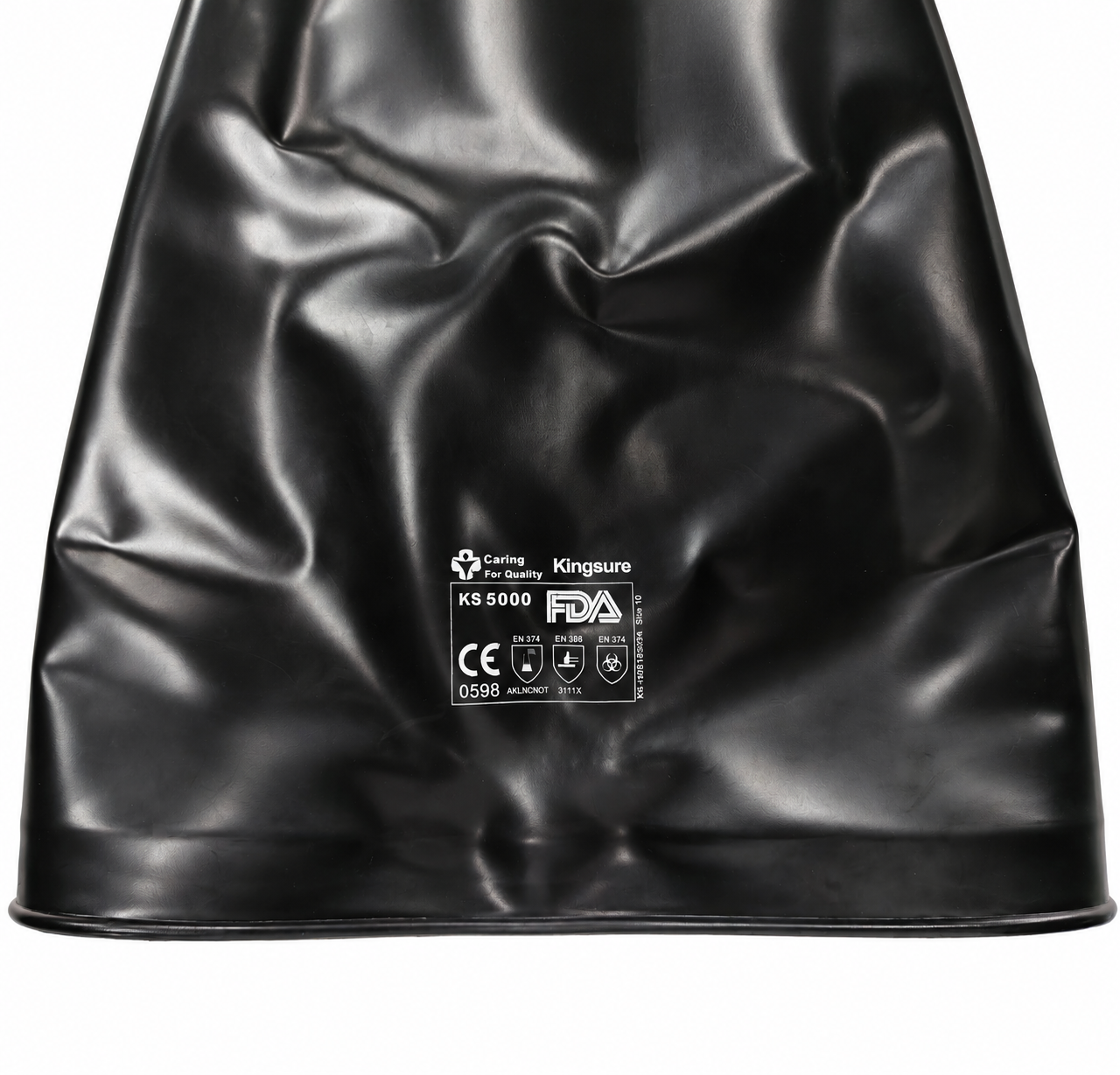
Figure 2. Markings on a Kingsure isolator glove. Chemical, mechanical and microorganism protection use separate pictograms.
Read the visible information in separate groups:
| Visible marking | Interpretation |
|---|---|
| KS 5000 | Product model, used to match the instructions, test information and declaration of conformity |
| EN 374 + flask shield + chemical letters | Chemical protection information; for example, A identifies methanol, K 40% sodium hydroxide and L 96% sulfuric acid |
| EN 388 + 3111X | Mechanical performance sequence, not chemical codes or chemical breakthrough time |
| EN 374 + biohazard shield | Microorganism protection information; VIRUS is not printed in this photograph |
| CE + 0598 | CE conformity marking and notified body identification number; 0598 is not a performance level or sterilisation cycle count |
| Size 10 | Sizing information, unrelated to the EN 374 classification |
Using the EN 388:2016 code structure, 3111X identifies abrasion Level 3, blade cut Level 1, tear Level 1, puncture Level 1 and X for the fifth-position ISO cut test. X means not tested or not applicable.[12]
For Category III PPE, the four digits after CE identify the notified body responsible for the relevant production conformity supervision. They serve a different purpose from chemical test results.[7]
The photograph abbreviates the standard above both protection pictograms to “EN 374”; it does not show the full edition, part number or Type. The symbols identify the risk categories, but this photograph alone does not establish a Type A or VIRUS claim. Read the complete standard information with the instructions and declaration of conformity for the KS 5000.
Likewise, interpret older EN 374 markings under their own edition. Classification and marking changed between 2003 and 2016; the older low chemical protection beaker pictogram was removed from the later system. Similar flask symbols do not make classifications from different editions interchangeable.[10]
6. How should EN 374 information be used when selecting pharmaceutical isolator gloves?
In pharmaceutical facilities, gloves may contact cleaning agents, disinfectants, acid and alkali solutions, organic solvents and process materials. EN 374 markings help identify reference chemicals included in the protection claim. Assessing a particular process also requires the performance data for the relevant glove model.
1. Code P identifies liquid 30% hydrogen peroxide, not VHP cycle counts
P identifies 30% hydrogen peroxide in the reference list. It expresses the chemical barrier performance against that test medium; it does not indicate how many vaporised hydrogen peroxide (VHP) treatments a glove can withstand.
VHP suitability concerns gaseous hydrogen peroxide, cycle temperature and humidity, exposure conditions and material condition after repeated treatments. EN 374 liquid permeation testing concerns the rate at which a chemical passes through material under specified liquid contact conditions. The two data sets answer different questions.
2. K does not represent all cleaning agents, and A does not represent all alcohols
K identifies 40% sodium hydroxide. Its result cannot automatically be applied to blended cleaners containing surfactants, solvents or other ingredients. A identifies methanol and does not replace data for ethanol or isopropyl alcohol.
Not all commonly used substances, including ethanol, isopropyl alcohol and peracetic acid, appear in the 18-code table. A chemical’s absence from the letter list does not prevent testing; absence of a corresponding letter does not by itself mean incompatibility. Look up the name, CAS number, concentration and test conditions in the product’s chemical performance data.[6]
3. For long isolator gloves, examine both palm and sleeve data
The protected areas of a long glove include its palm and sleeve. The 2016 requirements discussed here include additional permeation sampling 80 mm from the end of the cuff for gloves at least 400 mm long. This is especially relevant to long isolator gloves: read the sampling location in the report.[10]
4. Chemical protection, treatment resistance and installed integrity each need their own data
| Question | Data to read |
|---|---|
| How does the glove act as a barrier to a particular liquid chemical? | Model-specific breakthrough time, level and degradation result for that chemical |
| Is bacteria, fungi or virus barrier protection claimed? | Relevant microorganism standard, pictogram and VIRUS marking |
| How many steam or VHP treatments can be completed? | Treatment method, cycle conditions and supported cycle count |
| Does the glove remain sealed after installation on an isolator port? | Integrity test results for the installed glove and its connections |
The scope of these tests shows why chemical letters are not sterilisation performance codes, and why a microorganism pictogram is not a record of installed isolator sealing integrity. Match each data set to the question it addresses.
7. Frequently asked questions about EN 374 markings
Is Type A the highest EN 374 chemical resistance level?
Type A requires more reference chemicals to meet the permeation threshold, but it is not a Level 6 result for any individual chemical. For a specific medium, compare breakthrough time and degradation data.
Why does Type C have no chemical letters?
Under the 2016 marking rules explained here, Type C has no chemical codes beneath the pictogram. It still has a minimum permeation requirement; consult the relevant information for the tested chemical and result.[7]
Do more chemical codes mean longer breakthrough times for every medium?
No. The number of codes reflects the number of listed qualifying chemicals. Read each breakthrough time separately. Two gloves both marked K may achieve Level 2 and Level 6 respectively.
Does a microorganism pictogram mean the glove is sterile?
No. The pictogram identifies barrier performance. Read the product information for sterilisation, packaging and the sterile condition in which it is supplied.
Can the four digits after CE be converted into a glove protection level?
No. They identify a notified body, not a chemical, abrasion or sterilisation performance score.
When reading Kingsure isolator glove protection information, follow the sequence standard edition → Type classification → chemical letters → breakthrough times → degradation results → microorganism markings, then match each item to the working chemicals and process requirements.
References
[1] European Commission: Personal protective equipment and Regulation (EU) 2016/425
[2] MAPA Professional: EN 374 chemical and microorganism protection
[5] Centexbel: EN ISO 374-2:2019 penetration testing
[6] DuPont: Chemical protection test methods and breakthrough criteria
[7] Ansell: Chemical glove instructions for use and marking explanations
[8] Ansell: Permeation breakthrough and degradation data guidance
[9] MAPA Professional: Understanding EN ISO 374-1
[10] Ansell: EN 374 standard changes guide