
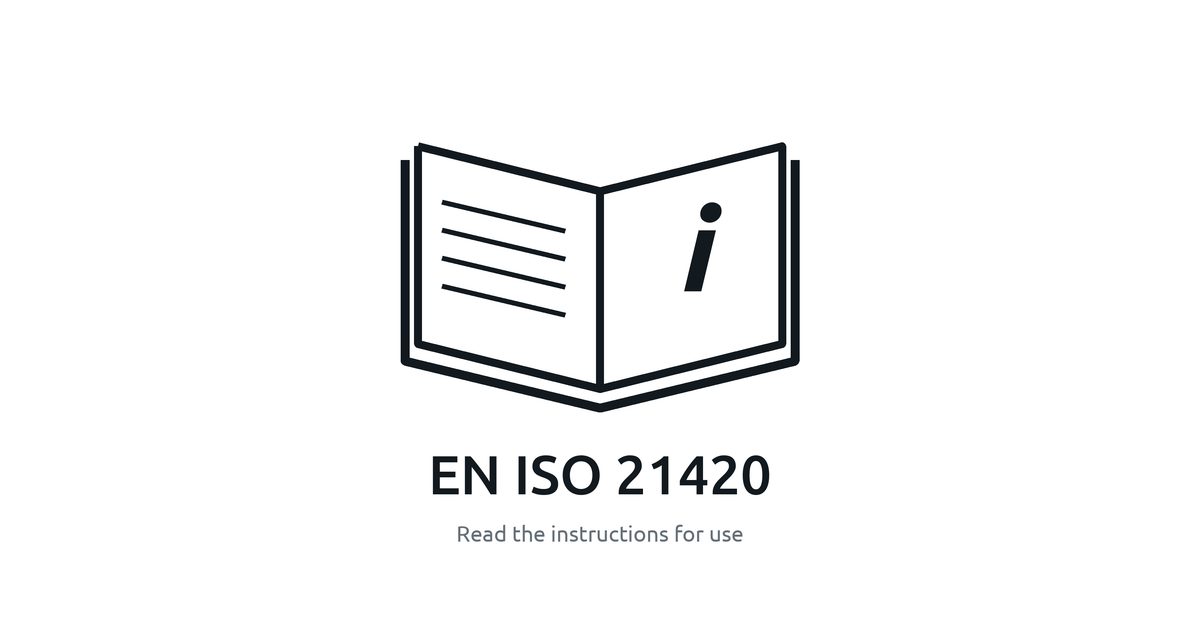
Isolator glove markings, packaging and technical documents may show EN ISO 21420 alongside EN 388, EN ISO 374 and an open-book “i” symbol. Understanding these references helps users check basic glove requirements, instructions and intended use.
EN ISO 21420 establishes general requirements and test methods for protective gloves. It covers design, material safety, sizing and dexterity, markings and user information. Mechanical or chemical protection must be assessed through the relevant specific standards.[1]
1. What is EN ISO 21420?
The standard is titled Protective gloves — General requirements and test methods. Its scope also includes arm protectors and gloves permanently incorporated in containment enclosures, making it relevant to fixed gloves used in isolators and gloveboxes.[1]
EN ISO 21420 replaced the former EN 420 general requirements standard.[4] As of October 2026, BSI lists EN ISO 21420:2020+A1:2024 as the current European adoption. The European A1:2024 amendment corresponds to ISO 21420:2020/Amd 1:2022.[2][3] A glove may display the shorter reference EN ISO 21420 or EN ISO 21420:2020. Check the declaration, certificate and instructions for the specific model to establish the applicable edition.
EN ISO 21420 is a technical standard. Regulation (EU) 2016/425 provides the EU legal framework for personal protective equipment. CE marking relates to compliance with applicable legislation; a standard reference cannot be treated as a CE mark.[10]
2. What does the standard evaluate?
Design and construction
A glove should support its intended protective function and the work being performed. Materials, seams and construction should not compromise overall performance. Reusable multilayer gloves must also address separation of the layers during donning and doffing.[7] For isolator glove selection, this points to checking finger movement, sleeve length and working reach after installation.
Material safety: evaluating the glove itself
Innocuousness addresses the effect of glove materials on the wearer. This is a different assessment from the glove’s ability to resist an external chemical.[7] The main checks and their material conditions can be summarised as follows:[4][5]
| Check | Main material or component condition | Requirement summary |
|---|---|---|
| pH | Glove materials, using applicable test methods | Greater than 3.5 and less than 9.5 |
| Hexavalent chromium, Cr(VI) | Leather | Less than 3 mg/kg |
| Restricted aromatic amines released from azo colourants | Dyed leather and textiles | Less than 30 mg/kg for each restricted amine |
| Dimethylformamide, DMFa | Materials containing polyurethane (PU) | Less than 1,000 mg/kg, or 0.1% by mass |
| Polycyclic aromatic hydrocarbons, PAHs | Rubber and plastics in direct skin contact | Less than 1 mg/kg for each of 8 restricted PAHs |
| Nickel release | Metal parts in prolonged skin contact | Less than 0.5 μg/cm²/week |
Applicability depends on the actual material construction. Leather chromium tests or metal nickel-release tests do not automatically apply to every glove. For rubber isolator gloves, check the materials touching the skin, relevant restricted substances and manufacturer information about allergens.[4][8]
Sizing, fit and dexterity
Glove sizing refers to the hand the glove is intended to fit, including hand circumference and length. For example, size 8 has reference dimensions of 203 mm circumference and 182 mm hand length.[6] Hand size and isolator glove port diameter are separate parameters and must be checked separately during equipment selection.
EN ISO 21420 removed the uniform minimum glove lengths for each size that appeared in EN 420. A specific application or protective standard may still require a minimum length.[5] Sleeve length, coverage and attachment design therefore remain relevant for isolator gloves.
Dexterity is assessed by picking up steel pins of different diameters while wearing the glove, including the specified condition of three pickups within 30 seconds. A smaller pin corresponds to a higher dexterity level.[6][7]
| Dexterity level | Smallest pin diameter that can be picked up |
|---|---|
| 1 | 11.0 mm |
| 2 | 9.5 mm |
| 3 | 8.0 mm |
| 4 | 6.5 mm |
| 5 | 5.0 mm |
This result describes dexterity in the specified test. It is neither a cut-resistance level nor an overall protection score. Fine work inside an isolator should also be evaluated with the actual workstation, tools and glove thickness.
3. How should EN ISO 21420 glove markings be read?
Reading the standard reference and book symbol
| Marking element | Meaning |
|---|---|
| EN ISO 21420 | European adoption of the ISO general requirements standard for protective gloves |
| :2020 | Year of the base edition |
| +A1:2024 | Incorporation of the 2024 European amendment |
| Open-book “i” | Read the manufacturer’s instructions for use |
Manufacturers may place the open-book “i” alongside EN ISO 21420 to direct users to product information.[9] The symbol does not indicate abrasion, cut, chemical or electrostatic performance, or establish that a glove is sterile.
Checking the remaining markings and documents
General marking requirements also address manufacturer identification, model, size, relevant protective pictograms and performance levels, manufacturing date or other traceability information, and an obsolescence date where applicable. Where glove characteristics prevent direct marking, the required information can be placed on the first packaging enclosure under the applicable provisions.[8]
A useful reading sequence is model and size → traceability → specific protection markings → instructions. Seeing EN ISO 21420 alone does not establish suitability for a particular chemical. Check the test coverage and use limitations for that model.
4. How does it relate to EN 388 and EN ISO 374?
EN ISO 21420 supplies general requirements. Specific protective standards address particular hazards.[1]
| Standard | Main assessment | What to read |
|---|---|---|
| EN ISO 21420 | General requirements, markings and user information | Model, sizing, material safety and instructions |
| EN 388 | Abrasion, cutting, tearing, puncture and other mechanical performance | Performance codes in the prescribed order below the pictogram |
| EN ISO 374-1 | Protection against dangerous chemicals | Type A/B/C and the relevant test chemicals |
| EN ISO 374-5 | Protection against microorganisms | Bacteria, fungi and whether VIRUS is marked |
| EN 16350 | Electrostatic properties for particular applications | Supporting tests and conditions of use |
The scopes of these protective standards are described in the testing-body and manufacturer sources.[4][9][11] Several references may appear on one glove, but each must be interpreted separately. For example, a code below EN 388 describes mechanical performance; it is not an EN ISO 21420 performance code.
5. Applying the information to isolator glove selection
Based on these standard scopes, combine marking checks with equipment and process requirements:
- Match the model to its documents. Markings, packaging, instructions and test records should refer to the same model, material and specification.
- Check hand fit and equipment attachment separately. Hand circumference and length affect fit; port dimensions, sleeve length and connection design affect installation.
- Review hazard-specific data. For chemical contact, check the substance, concentration, temperature and contact conditions. For mechanical hazards, review the relevant mechanical results.
- Evaluate actual operations. Use dexterity results as a reference, then assess real handling, gripping and tool use at the workstation.
- Verify process requirements separately. Installed leak tightness, sterilisation or disinfection compatibility, cleanliness and replacement intervals require the relevant evidence and process validation. They cannot be inferred from EN ISO 21420 alone.
6. Frequently asked questions
Is EN ISO 21420 a chemical-resistance certification?
It specifies general glove requirements. Chemical resistance must be assessed using the relevant specific test data and actual exposure conditions.
Is the open-book “i” an exclusive logo for the standard?
It is a read-instructions information symbol that may appear beside a standard reference. Article artwork should describe it as a marking illustration or read-instructions pictogram.
Does the reference establish isolator system leak tightness?
No. Installed system leak tightness also involves the attachment, seals and test method, and requires the appropriate validation.
To review isolator glove selection information with Kingsure, provide the glove model, contact substances, port dimensions and operating conditions so the required technical information can be identified.
References
This article provides a technical interpretation. Consult the standard and the manufacturer’s model-specific documentation for full applicability, test procedures and conformity decisions. Edition and source information checked on 13 October 2026.
- ISO — ISO 21420:2020, scope and current status
- BSI — BS EN ISO 21420:2020+A1:2024
- EVS — EN ISO 21420:2020+A1:2024, relationship to the ISO amendment
- SATRA — The requirements of EN ISO 21420:2020+A1:2024
- SATRA — EN ISO 21420:2020, test overview
- Granberg — EN ISO 21420:2020, sizing and dexterity tables
- Ejendals — EN ISO 21420:2020 technical summary
- Ansell — EN ISO 21420:2020 Standard Guide, marking and user information
- Ansell — Chemical Resistance Instructions for Use, symbols and their meaning
- European Commission — Personal protective equipment (PPE)
- SATRA — EN 388:2016+A1:2018, mechanical risks