
Isolator, glovebox and RABS gloves often carry standard numbers, pictograms and a sequence of numbers or letters. These identify different protective properties. EN 388 covers protection against mechanical risks, principally abrasion, cutting, tearing and puncture. Gloves claiming impact protection may also carry an additional marking.
To read a marking, first identify its pictogram, then interpret each character in its fixed position. In the 4111X marking shown in this article, the first “4” refers specifically to abrasion resistance; the remaining characters describe other test results.
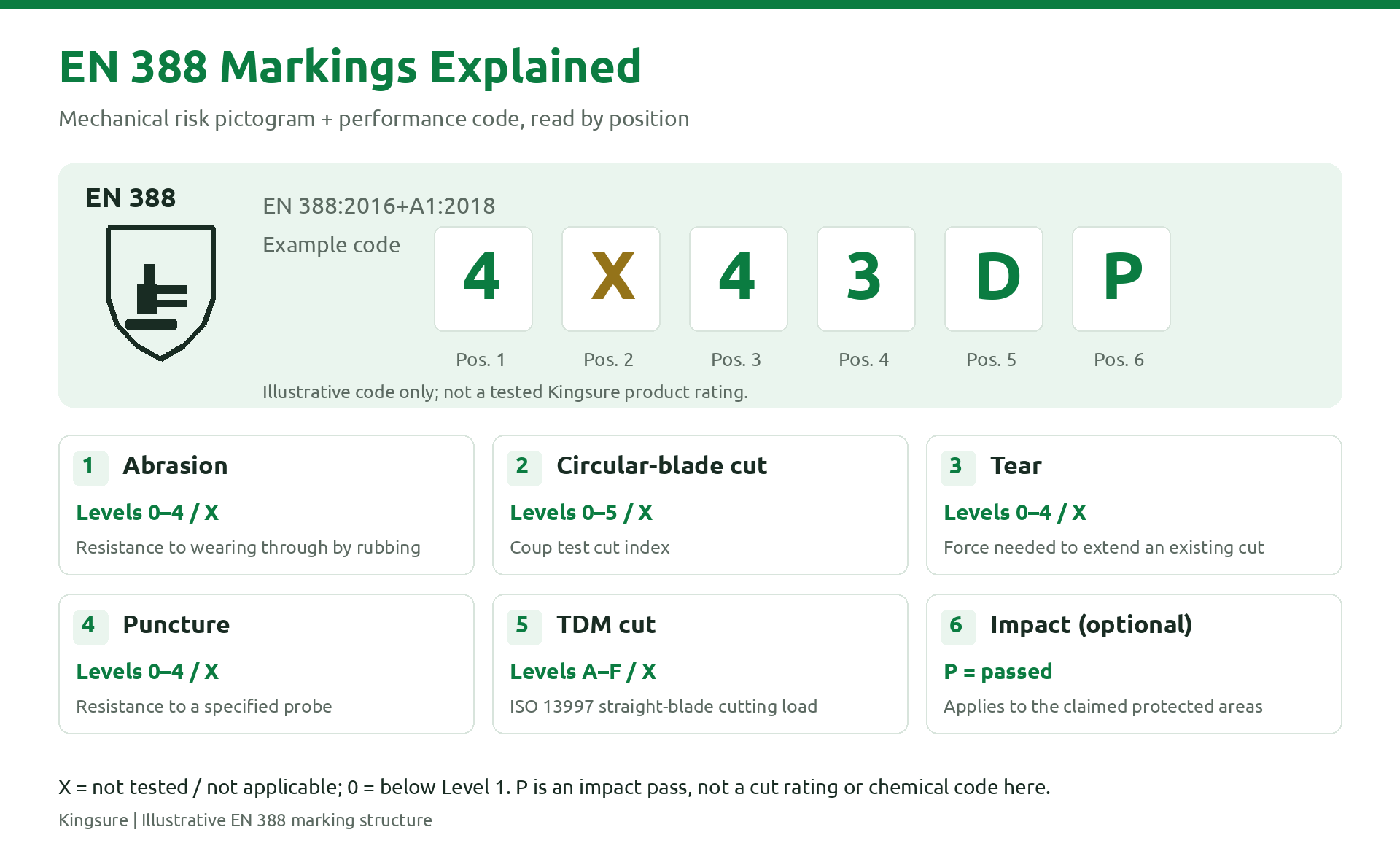
Figure 1. EN 388 marking structure. 4X43DP is an illustrative example, not a tested performance rating for a Kingsure product.
1. What is EN 388, and how does it relate to the EU PPE Regulation?
EN 388, Protective gloves against mechanical risks, specifies performance requirements, test methods, markings and information to be supplied by manufacturers. This article explains EN 388:2016+A1:2018. BSI currently lists this edition as current and under review.[1]
EN 388 is a technical standard; Regulation (EU) 2016/425 on personal protective equipment provides the legal framework. The PPE Regulation sets essential health and safety requirements and conformity assessment obligations for products placed on the EU market. Relevant harmonised standards support assessment of conformity with the requirements they cover.[2]
EN 388 performance codes and the CE marking therefore serve different purposes. The code identifies individual mechanical performance levels; the CE marking concerns conformity with applicable legislation. An EN 388 code alone is not a complete record of certification information.
“A1:2018” identifies the 2018 amendment to the standard. It is separate from the TDM cut resistance levels A–F discussed below.
2. In what order are the pictogram and performance codes read?
The EN 388 mechanical risk pictogram normally has a shield outline with a mechanical risk symbol inside. The standard number appears nearby, with the performance code below.[3]
Under the edition discussed here, the code is read from left to right:
| Code position | Test | Common marking | What it describes |
|---|---|---|---|
| 1st | Abrasion resistance | 0–4, or X | Resistance to wearing through by rubbing |
| 2nd | Circular-blade cut resistance, Coup test | 0–5, or X | Cut index obtained using a circular blade |
| 3rd | Tear resistance | 0–4, or X | Force needed to extend an existing cut |
| 4th | Puncture resistance | 0–4, or X | Resistance to a probe of specified dimensions |
| 5th | ISO 13997 straight-blade cut resistance, TDM test | A–F, or X | Cutting load level for a specified blade travel |
| 6th, optional | Impact protection | P | The relevant impact test has been passed |
Each property is assessed separately; the levels cannot be added into an overall score. Within the same test, a higher number or later letter generally indicates a higher threshold. Different properties use different methods and units.
The standard sets a minimum performance threshold for using the mechanical risk pictogram: at least one specified protective property must achieve Level 1 or Level A. Other applicable requirements of the standard must also be met.[3]
3. Real example: how to read 4111X on the Kingsure KS 2000
The illustration below retains the supplied KS 2000 photograph and enlarges its printed label. The code visible beneath the EN 388 pictogram is 4111X.
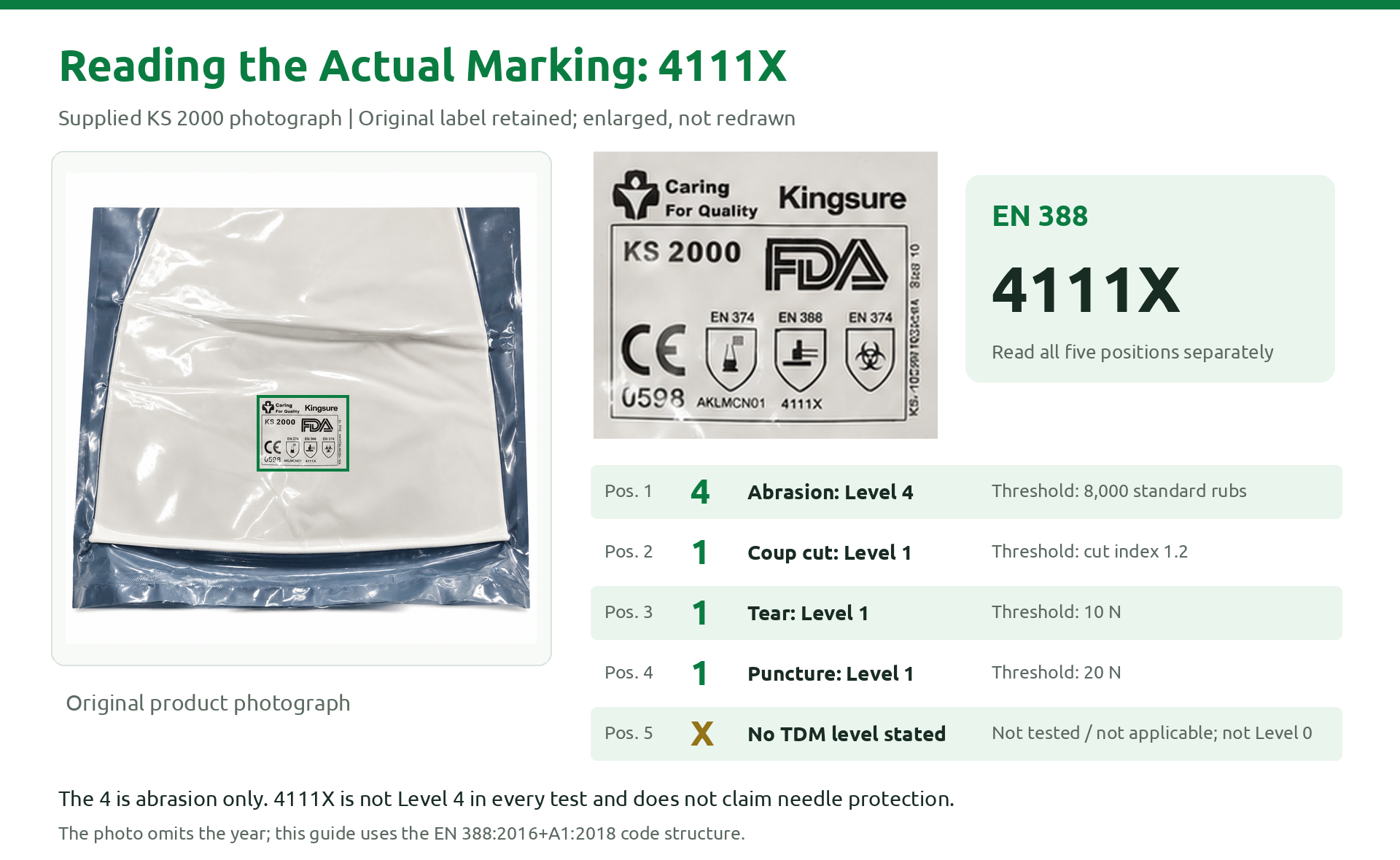
Figure 2. The actual marking, explained character by character. The photograph shows “EN 388” without a year. The five-character code is interpreted here using the EN 388:2016+A1:2018 structure.
| Position | Character | Meaning | Classification threshold |
|---|---|---|---|
| 1st | 4 | Abrasion Level 4 | 8,000 standard abrasion rubs |
| 2nd | 1 | Circular-blade cut Level 1 | Cut index 1.2 |
| 3rd | 1 | Tear Level 1 | 10 N |
| 4th | 1 | Puncture Level 1 | 20 N |
| 5th | X | No TDM cut level is stated | Not tested or not applicable |
The values in this table are classification thresholds, not the individual measured results of this glove.[4]
When reading 4111X, keep the following points in mind:
- Abrasion Level 4 applies only to abrasion. Circular-blade cut, tear and puncture resistance are each marked Level 1.
- A cut index of 1.2 is a relative laboratory measure. It cannot be converted into a number of blade contacts that a glove can withstand in service.
- The final X occupies the TDM position. It does not state an A–F level and cannot be substituted with Level 0.
- This code has no P. It does not provide a basis for an impact protection claim.
Other markings, including EN 374, appear nearby. Read each code with its own pictogram; chemical letters must not be appended to the EN 388 mechanical code.
4. What do abrasion, cut, tear and puncture tests measure?
1. Abrasion: resistance to wearing through under specified rubbing conditions
Abrasion testing uses specimens taken from the glove palm. They are rubbed under specified pressure and abrasive conditions, and the number of rubs required to reach the prescribed damage endpoint is recorded.[3]
For isolator gloves, this helps explain the material’s resistance to repeated surface contact and rubbing. However, surface condition, contact pressure, movement and chemical exposure differ in use. Standard abrasion rubs cannot be converted directly into days of service or a replacement interval.
2. Circular-blade cut: read the index, not a number of cuts
The Coup test uses a reciprocating, rotating circular blade. A relative cut index is calculated from the cut-through results for the glove specimen and a reference material.[4]
Levels 1–5 in the second position belong to this method. Level 5 is its highest numerical classification; there is no direct conversion between that level and TDM Level F.
3. Tear: resistance to propagation of an existing cut
Tear testing uses a specimen with a pre-cut slit and measures the force needed to extend the tear.[3]
This is relevant to crack propagation after snagging. It evaluates tearing, a different property from rubber tensile strength or elongation. A high tear rating also does not justify continued use of an isolator glove that already has a hole or tear.
4. Puncture: resistance to a specified probe, not a needle protection rating
The puncture test measures the force needed for a probe of specified dimensions to penetrate the specimen.[4]
An EN 388 puncture level does not directly demonstrate resistance to hypodermic needles, fine needles or other fine sharp points. Ansell’s guidance explicitly distinguishes EN 388 puncture ratings from needle protection.[5] For tasks involving needles or broken glass, assess the specific damage mechanism rather than relying solely on the fourth character.
Thresholds for the four numerical tests
| Test | Level 1 | Level 2 | Level 3 | Level 4 | Level 5 |
|---|---|---|---|---|---|
| Abrasion, standard rubs | 100 | 500 | 2,000 | 8,000 | — |
| Circular-blade cut, cut index | 1.2 | 2.5 | 5.0 | 10.0 | 20.0 |
| Tear, N | 10 | 25 | 50 | 75 | — |
| Puncture, N | 20 | 60 | 100 | 150 | — |
These are the minimum thresholds for the respective levels. “—” means that the test has no classification at that level.[4] In the first four positions, 0 means that the test was performed but the Level 1 threshold was not reached.[3]
5. Why are cut resistance ratings shown as both numbers and A–F letters?
The EN 388 marking has two cut resistance positions because they refer to different test methods.
The circular blade repeatedly acts on the same area. Some materials blunt the blade, affecting how representative the result is. Where the specified blunting condition occurs, ISO 13997 straight-blade testing becomes the reference method for cut resistance.[4][6]
The TDM method uses a straight blade at different loads to determine the cutting load associated with cut-through over a 20 mm blade travel. The result is expressed in newtons, N, and classified from A to F.[3]
| TDM cut resistance level | A | B | C | D | E | F |
|---|---|---|---|---|---|---|
| Cutting load threshold, N | 2 | 5 | 10 | 15 | 22 | 30 |
Circular-blade numerical levels and TDM letter levels cannot be interchanged directly. In “4X43D”, the second-position X provides no circular-blade level, while the fifth-position D indicates the TDM Level D threshold. Likewise, the second-position “1” in 4111X cannot be used to infer an A–F level for its fifth-position X.
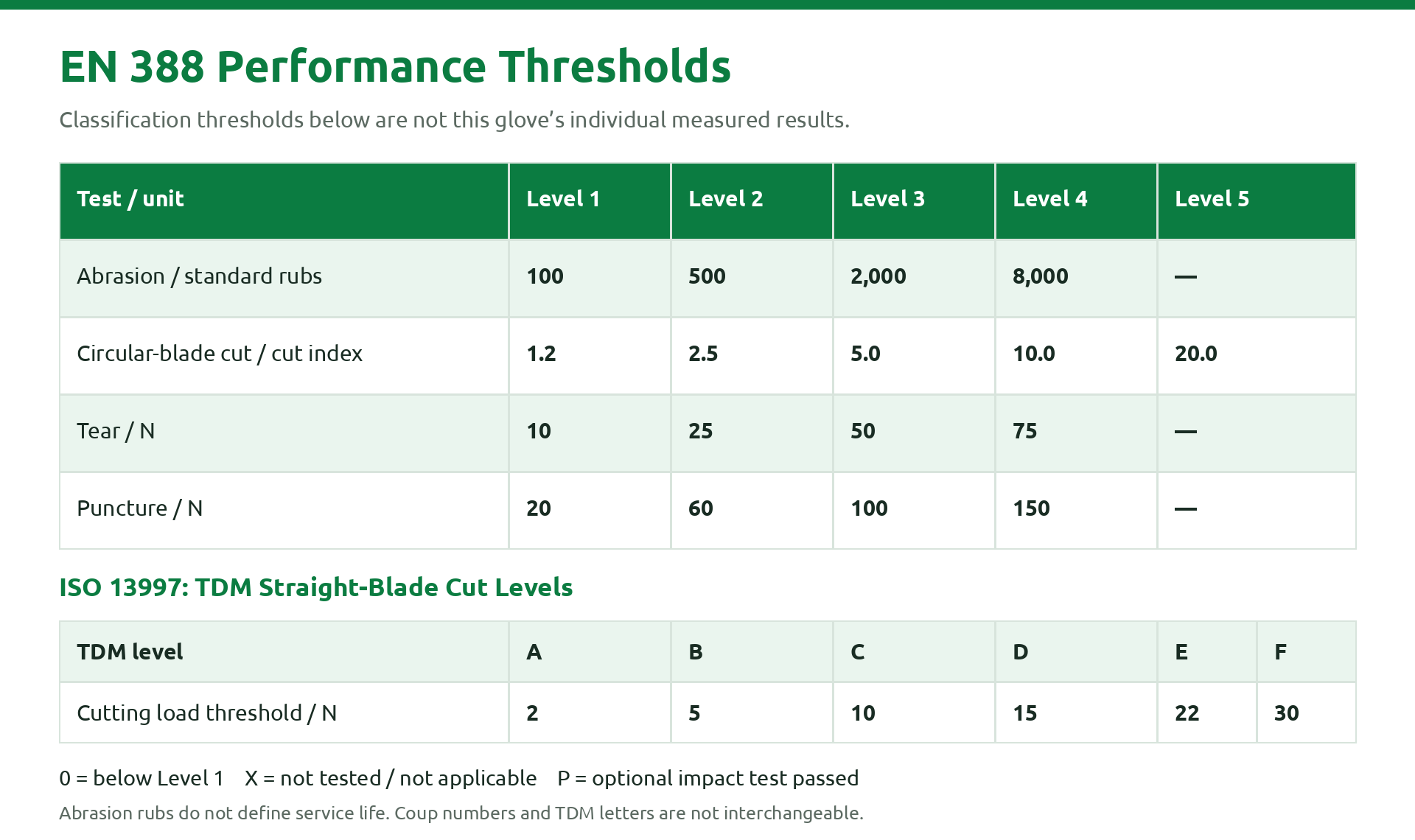
Figure 3. EN 388 threshold reference. The table explains the standard; it is not a complete test report for a particular glove.
6. What do X, 0 and P mean?
X: not tested or not applicable
X occupies the position of a particular test and means that it was not performed or is not applicable.[5][6] Its position matters: second-position X refers to the circular-blade test; fifth-position X refers to TDM.
X must not be interpreted as a pass or replaced with Level 0. The printed code alone does not identify the particular reason for using X.
0: tested, but below the Level 1 threshold
0 indicates that the property was tested but did not achieve Level 1.[3] It conveys different information from an X indicating that the relevant test was not performed.
P: passed the optional impact test
P may be added after the mechanical code when a glove claims impact protection for the relevant area and passes the applicable test.[6][7]
P is impact information, not an A–F classification. It does not mean that the whole glove is suitable for all impact, trapping or crushing hazards. Read the protected areas in the instructions for use; this protection does not automatically extend to the fingers.[6]
The same letter P, when used as a chemical code beneath the EN ISO 374 chemical pictogram, identifies 30% hydrogen peroxide as the test chemical.[8] Read the pictogram, code position and standard number together.
7. How do EN 388 ratings help with isolator and RABS glove selection?
An isolator glove is both an operating interface and part of a barrier system. Mechanical codes help distinguish the material’s performance against rubbing, cutting, snag-related tearing and penetration by a specified probe.
The following considerations connect the tests to practical tasks:
| Task characteristic | Mechanical property to examine | Conditions to consider |
|---|---|---|
| Repeated contact with trays, containers or equipment surfaces | Abrasion | Contact pressure, surface roughness and movement frequency |
| Contact with metal edges or objects presenting a cutting risk | Circular-blade and TDM cut resistance | Edge geometry, force and contact direction |
| Possible snagging while moving items | Tear | Snagging points, local stretching and glove size |
| Contact with pointed components | Puncture | Point geometry; fine-needle hazards require separate assessment |
This table provides an application assessment approach based on the test properties. It does not automatically establish suitability of a particular model for a task or chemical.
EN 388 component tests generally use palm specimens. Palm results cannot automatically be applied to fingertips, finger webs, sleeves or port connections. Ansell’s instructions explicitly address palm testing and differences in construction between glove areas.[8]
Mechanical ratings, chemical protection and integrity answer different questions
- EN 388: How does the material perform in specified mechanical tests?
- Relevant EN ISO 374 standards: What protection is claimed against tested chemicals or microorganism risks?
- Glove integrity testing: Does the glove system currently have detectable leakage or damage?
- Sterilisation and disinfection suitability: Can the product withstand the treatment conditions and cycles used?
These information sets jointly support selection and use management. EN 388 codes do not specify VHP cycle counts, steam sterilisation life, chemical permeation times or leakage results for a glove in service.
EU GMP Annex 1, Section 4.21, requires appropriate mechanical and chemical resistance for isolator and RABS glove systems, with replacement frequency defined in the contamination control strategy (CCS). Isolator glove integrity testing should generally take place at least at the beginning and end of each batch or campaign. Visual examination is also associated with each use and with manipulations that may affect system integrity. RABS gloves likewise require visual examination with each use and integrity testing at defined intervals.[9]
Manage material performance ratings and the integrity of gloves in service separately. A new glove’s printed rating does not describe its condition after rubbing, chemical contact or disinfection.
8. What changed from EN 388:2003 to 2016+A1:2018?
EN 388:2003 commonly used four numerical positions: abrasion, circular-blade cut, tear and puncture. The edition discussed here retains these properties and introduces TDM straight-blade cut testing and testing for claimed impact protection. Abrasion and circular-blade procedures were also revised.[6]
When comparing gloves, consider the edition, test method, material construction and applicable area. The number or appearance of characters alone does not establish which glove performs better.
9. Frequently asked questions
What does EN 388 code 4111X mean?
Under the code structure discussed here, it means abrasion Level 4, circular-blade cut Level 1, tear Level 1 and puncture Level 1. The fifth-position TDM rating is X: not tested or not applicable.
Can 4111X be described as “Level 4 cut protection”?
No. The first 4 is the abrasion rating. Circular-blade cut resistance is the second-position 1; no TDM A–F level is given in the fifth position.
Are X and 0 the same in EN 388?
No. X means that the relevant test was not performed or is not applicable. In the first four positions, 0 means that testing did not reach Level 1.
Does EN 388 puncture Level 4 demonstrate hypodermic needle protection?
No. EN 388 puncture testing uses a specified probe. Fine-needle hazards require appropriate evidence of needle puncture resistance.
What do F in the fifth position and P in the sixth position mean?
F is the highest letter level in the TDM classification discussed here. P means that the optional impact test was passed. They refer to different properties.
Can an EN 388 rating determine an isolator glove replacement interval?
Not on its own. Replacement also depends on operations, chemical contact, treatment conditions, glove condition and integrity management.
Start with the code, then match the process requirements
Read the standard and pictogram first, then each individual rating. 4111X defines separate mechanical performance levels rather than a single overall protection grade.
Kingsure provides products and selection support for isolator, RABS and glovebox applications. When discussing a requirement, include port dimensions, operating tasks, contact chemicals and disinfection or sterilisation methods so that mechanical protection, material compatibility and equipment fit can be considered together.
References
[1] BSI: BS EN 388:2016+A1:2018—standard description and status
[2] European Commission: Personal protective equipment—PPE Regulation and harmonised standards
[3] SATRA: The EN 388 glove standard—testing, classification and marking
[4] ATG: EN 388:2016+A1:2018—test properties and classification thresholds
[5] Ansell: EN 388: Understanding the European Standard for Gloves—X and the limits of puncture ratings
[6] Ansell: What are impact gloves?—edition changes, X and P
[7] Honeywell: Technical Guide—Understanding Key Hand Protection Standards, PDF pages 9–10
Sources checked for the original article: 12 October 2026.