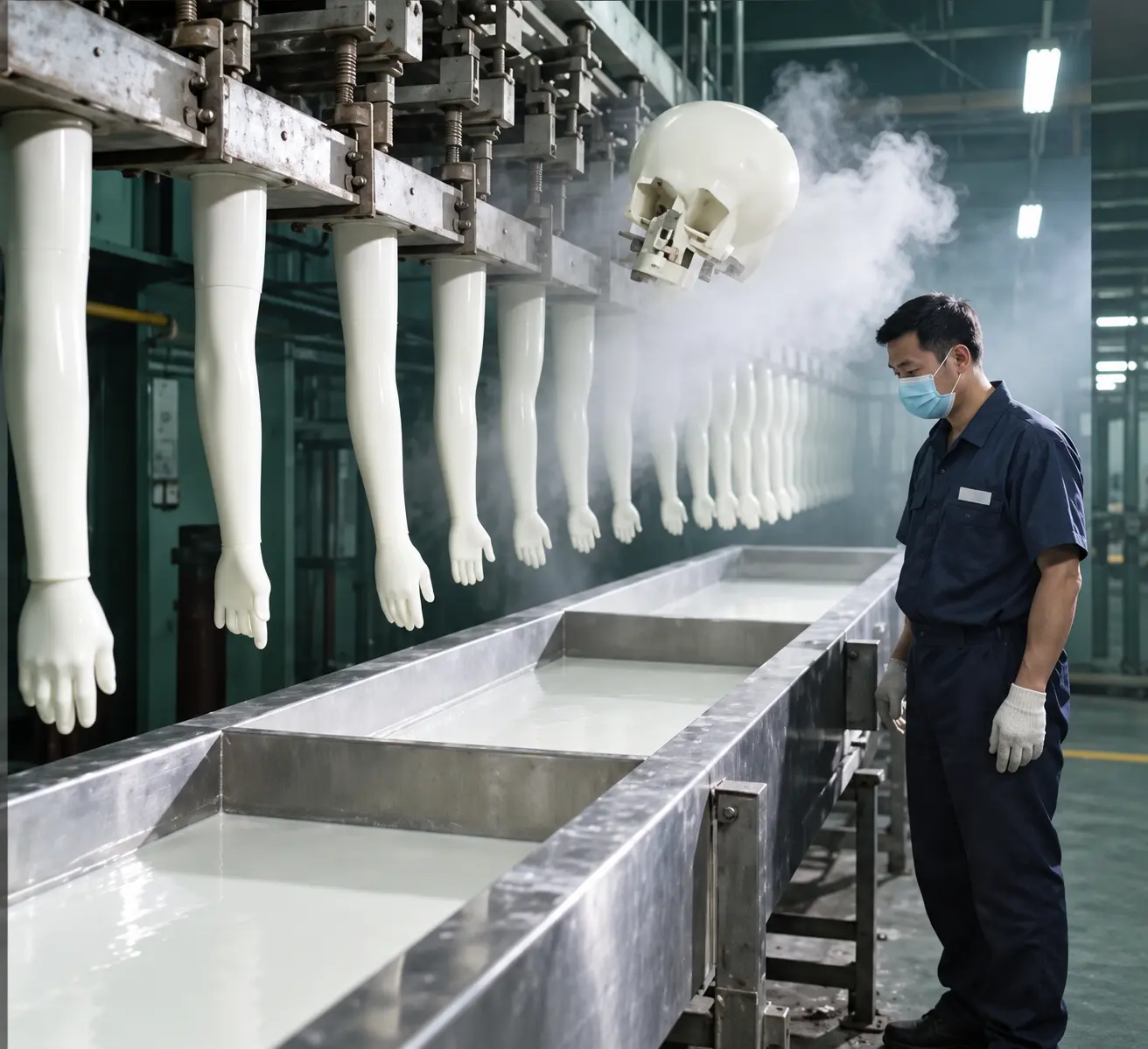
Traditional dipped rubber-glove production first uses chemical solvents to prepare a liquid rubber compound. A former is then dipped into the compound, and the coated material is dried to form the glove. Solvents continue to evaporate during compound preparation, open-tank dipping and drying, creating concerns for employee health, production safety and environmental emissions.
To address these long-standing process challenges, the Kingsure research and development team developed a new glove injection-molding process. It uses conventionally manufactured industrial rubber compound and does not require chemical solutions to prepare a dipping compound, reducing dependence on solvent-based rubber cement at the source.
How are traditional dipped rubber gloves manufactured?
In a conventional dipping process, glove formers pass through tanks of liquid rubber compound so the material adheres to their surfaces. Drying, vulcanization and stripping then turn the deposited material into finished gloves.
For some specialty rubber materials, manufacturers first dissolve the rubber with chemical solvents to produce a compound with suitable flow and stability. Some improved processes emulsify the dissolved rubber to reduce solvent use and control evaporation and emissions. Even then, compound preparation, solvent recovery and exhaust-gas treatment remain important parts of the overall process.
Three common chemical solvents used in rubber-cement preparation
Traditional solvent-based rubber compounds may use organic solvents such as toluene, ethyl acetate and methyl ethyl ketone. These substances help dissolve and disperse rubber, but they are also highly volatile, have low flash points and are flammable.
1. Toluene
Toluene is a volatile organic compound. Prolonged or high-concentration exposure can affect the central nervous system and can harm the skin, mucous membranes, liver and kidneys.
After entering the atmosphere, evaporated toluene can participate in photochemical reactions with nitrogen oxides under sunlight, contributing to ground-level ozone and secondary organic aerosols. Toluene also has a low flash point and is flammable, so storage, mixing and use require strict fire-prevention and ventilation controls.
2. Ethyl acetate
Ethyl acetate is also a volatile organic compound. Exposure to higher concentrations can irritate the skin, eyes and respiratory tract and may cause central-nervous-system symptoms such as headaches and dizziness.
After evaporation, ethyl acetate can also participate in atmospheric photochemical reactions. Its low flash point means that vapor-air mixtures can present fire and explosion risks.
3. Methyl ethyl ketone
Methyl ethyl ketone, also called 2-butanone and commonly abbreviated as MEK, can irritate the eyes, skin and respiratory tract at high vapor concentrations and may cause headaches and dizziness.
MEK is also a volatile organic compound. After entering the atmosphere, it can take part in the formation of ozone, peroxyacetyl nitrate and other secondary pollutants. Because MEK has a low flash point, production areas must control static electricity, ignition sources, ventilation and vapor concentration.
Main problems in traditional dipping
Traditional glove production depends most heavily on chemical solvents during processing and drying.
Processing: continuous evaporation from open tanks
During dipping, large numbers of glove formers pass through open tanks. Organic solvents in the compound continuously evaporate, with evaporation rates reaching 1–5 kg/m² per hour.
Solvent evaporation from open tanks can create several problems:
- Operators may inhale organic-solvent vapor, increasing occupational-health risks;
- Local accumulation of flammable vapor can increase fire and explosion risks;
- Evaporated substances and production wastewater can affect surrounding air, water, soil and biological environments;
- Production lines require ventilation, condensation, recovery and exhaust-gas treatment systems.
Drying: concentrated evaporation of solvent from the compound
During compound preparation, the ratio of chemical solvent to rubber can reach as high as 4:1. At this ratio, a glove containing 400 g of rubber may require about 1,600 g of chemical solvent to dissolve the rubber and prepare the compound.
During drying, the solvent evaporates and leaves the formed rubber behind. If a glove production line makes 100,000 pairs per year and uses 1.6 kg of solvent per pair, the annual quantity of chemical solvent involved can reach about 160 metric tons.
Manufacturers can recover part of the solvent through condensation, fractionation and adsorption. The complete system still involves recovery efficiency, exhaust treatment, residue disposal and secondary treatment of process media. These steps increase investment in facilities, operations management and environmental control.
Why does traditional dipping face sustainability challenges?
The central challenge is the close connection between glove formation and solvent-based rubber cement. As long as production depends on dissolving rubber with solvents, dipping in open tanks and high-temperature drying, manufacturers must continually manage solvent storage, evaporation, recovery and emissions.
This increases the pressure on employee protection, fire and explosion prevention, and environmental management. It also requires additional equipment, staffing and operating costs. Addressing the issue therefore begins with changing how the glove is formed and reducing the process's inherent demand for chemical solvents.
The breakthrough in Kingsure glove injection molding
After sustained development work, Kingsure created a new glove injection-molding process. It forms gloves directly from conventionally manufactured industrial rubber compound and does not first use toluene, ethyl acetate, methyl ethyl ketone or other chemical solvents to prepare a dipping compound.
Because production no longer depends on conventional solvent-based dipping, the process reduces the following operations at the source:
- Preparation of solvent-based rubber cement;
- Solvent evaporation from open compound tanks;
- Concentrated solvent evaporation during drying;
- Solvent condensation, recovery and exhaust-gas treatment;
- Subsequent disposal of wastewater and recovered process media.
This process changes glove production from conventional dipping to direct injection molding. It provides a new manufacturing route for specialty rubber gloves and isolator gloves while moving production toward safer, cleaner and more sustainable operations.
Advancing rubber-glove manufacturing at the process source
The solvent issues associated with traditional dipping cannot be solved completely through end-of-pipe recovery equipment alone. By changing how the rubber compound is formed, Kingsure reduces production's dependence on solvent-based compounds and systematically simplifies compound preparation, former dipping, solvent evaporation and emission-control operations.
Glove injection molding changes the production method and represents an important result of Kingsure's continued research into employee safety, product manufacturing and cleaner production.
To learn more about the material performance, dimensions and applications of Kingsure EPDM, CSM and Butyl isolator gloves, contact us for product information and selection support.